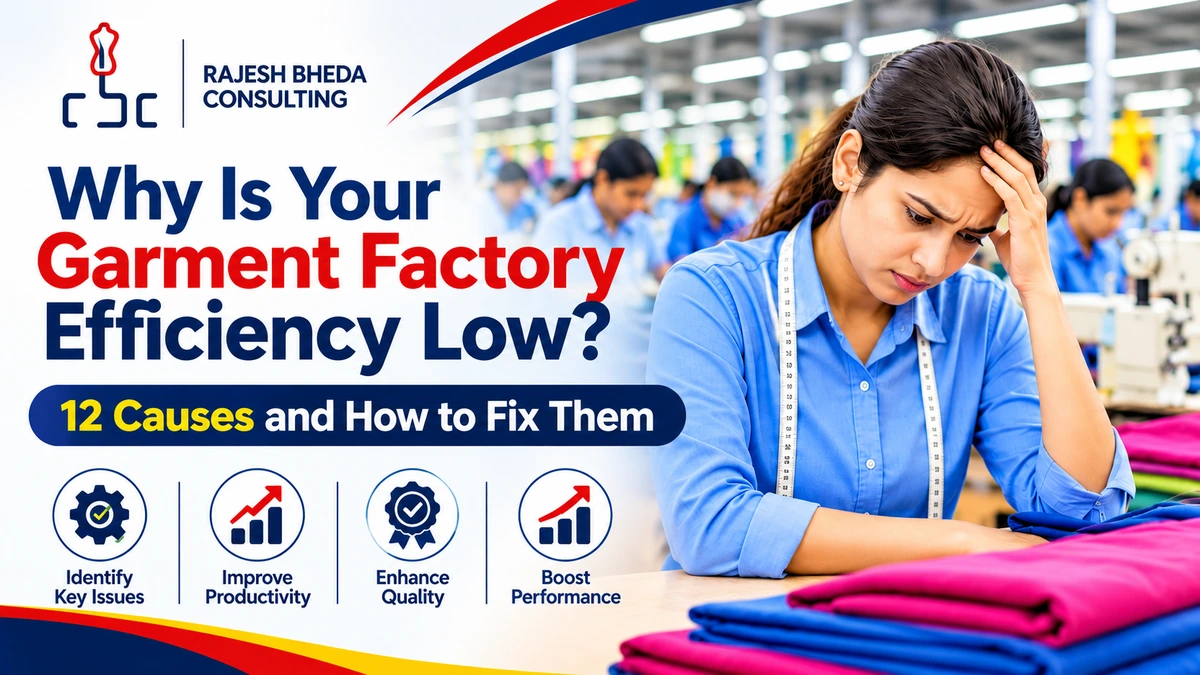
Low efficiency is one of the most common concerns in garment manufacturing.A factory may have experienced operators, modern machines, experienced production managers and full order books, yet still struggle to achieve the expected output.The first reaction is often to blame the sewing operators.“They are slow.”“We need more skilled workers.”“The target is too difficult.”But factory efficiency is rarely an operator-only problem.In many cases, the operator is simply working within a system that is not allowing them to perform at their best.Poor planning, unbalanced lines, excessive work-in-progress, machine downtime, quality problems, weak supervision and inconsistent methods can all reduce output even when individual operators are working hard.That is why improving garment factory efficiency starts with understanding where productive minutes are actually being lost.
What Does Garment Factory Efficiency Actually Mean?
In simple terms, efficiency compares the standard time that should have been required to produce the garments with the actual manpower time used.A commonly used calculation is:Line Efficiency (%) = Earned Standard Minutes ÷ Available Operator Minutes × 100For example, if a production line generates 3,600 standard minutes of output while using 4,800 available operator minutes, the efficiency would be:3,600 ÷ 4,800 × 100 = 75%The formula itself is simple.The difficult part is understanding why one line operates at 75%, another at 45%, and another at 85% despite apparently similar working conditions.The answer usually lies in the production system.Here are 12 common causes of low garment factory efficiency and what management teams can do about them.
1. Poor Line Balancing
One of the biggest causes of low sewing efficiency is poor line balancing.A garment is divided into many operations. Each operation takes a different amount of time.If one operator can produce 100 pieces per hour but the next operation can process only 60, pieces begin accumulating between the two operations.The first operator may eventually stop because there is nowhere to place additional work.At the same time, another operator further down the line may be waiting because they do not have enough pieces.The result is a line where some people are overloaded while others are underutilised.
What to do
Line balancing should not be treated as a one-time activity performed only before production starts.Production and industrial engineering teams should continuously monitor:
Output by operation
Work-in-progress between operations
Operator utilisation
Bottleneck operations
Capacity versus target
Hourly production
When bottlenecks appear, work can be redistributed, operators can be reassigned, helpers can be introduced, or the method can be improved.The objective is not simply to keep everyone busy.The objective is to create smooth production flow across the entire line.
2. Bottleneck Operations Are Identified Too Late
Almost every garment style has one or more operations that limit the capacity of the entire line.The problem is that many factories identify the bottleneck only after production has already fallen behind target.By that point, large quantities of WIP may have accumulated and valuable production hours have already been lost.A bottleneck can result from:
A difficult operation
Inadequate operator skill
Incorrect machine type
Poor workstation design
Method problems
Quality rework
Machine breakdown
Incorrect standard time
What to do
Bottlenecks should be identified during the initial hours of production and monitored throughout the style run.Hourly production boards and operation-level WIP monitoring can make problems visible quickly.More importantly, supervisors and industrial engineers should be trained to act immediately.Finding the bottleneck is only useful if the team is empowered to remove it.
3. Too Much Work-in-Progress
Many factories associate large bundles of garments with high productivity.The opposite can often be true.Excessive WIP hides problems.If hundreds of pieces are waiting between operations, a quality defect may continue for a long time before being detected.Large WIP also increases:
Material handling
Searching time
Floor congestion
Production lead time
Risk of mixing sizes or colours
Difficulty in identifying bottlenecks
Operators may appear busy, but the factory as a whole becomes slower.
What to do
The goal should be controlled flow rather than maximum WIP.Factories should define sensible WIP limits between operations and gradually move towards smaller bundles or more continuous flow where practical.When WIP suddenly increases at one operation, management should treat it as a warning signal.It usually means the downstream process is unable to keep pace.
4. Frequent Machine Downtime
A five-minute machine problem may appear insignificant.Multiply that by dozens of operators, several breakdowns and hundreds of working days, and the productivity loss becomes substantial.Machine downtime can come from:
Poor preventive maintenance
Delayed mechanic response
Improper machine settings
Needle or thread problems
Lack of spare parts
Incorrect machine allocation
Power or utility interruptions
The operator may still be present on the production floor, which means the factory is paying for the minute even though no value is being produced.
What to do
Factories should track downtime by machine, line and reason.The maintenance team should not only respond to breakdowns. It should identify recurring problems and eliminate their causes.Preventive maintenance should be planned around production requirements so machines remain reliable during critical style runs.The question should not be: “How quickly did we repair the machine?”It should be: “Why did the machine fail in the first place, and how do we prevent the same failure again?”
5. Operators Are Not Matched to the Right Operations
Two operators with similar experience may perform very differently on the same task.One may be excellent at collar attachment while another performs better on side seams or overlock operations.Yet factories often allocate operators based on who happens to be available.This creates a mismatch between operation requirements and operator capability.The result is slower production, greater quality risk and more supervision.
What to do
Maintain an updated operator skill matrix.The skill matrix should show which operations each worker can perform and their proficiency level.This helps production teams make better decisions during:
Style allocation
Line balancing
Absentee replacement
New style introduction
Training planning
A strong skill matrix also highlights where the factory is overly dependent on a small number of specialised operators.That becomes especially important when absenteeism increases.
6. High Absenteeism Disrupts the Production System
A line may be perfectly balanced at the start of the week.Then three experienced operators are absent.The production team replaces them with available workers, moves operators between processes and changes the line balance.Suddenly, output drops.This is why absenteeism is not only an HR issue.It is a production issue.Factories with high absenteeism often experience inconsistent daily efficiency because the production system is constantly being rebuilt around missing people.
What to do
Management should analyse absenteeism patterns rather than simply record attendance.Look at:
Department
Shift
Day of the week
Supervisor
Worker tenure
Seasonal patterns
Reasons for absence
At the same time, cross-training operators reduces the impact when experienced employees are unavailable.A flexible workforce gives the production team more options to maintain line balance.
7. Quality Problems Create Invisible Productivity Loss
A piece produced incorrectly is not productive output.It may have consumed operator time, machine time, electricity and material, but if it requires repair, the factory must effectively perform part of the work again.Rework is therefore one of the most expensive hidden losses in garment manufacturing.High defect rates also interrupt flow.Pieces are removed from the normal production sequence, repaired and reintroduced into the line.This creates additional handling and uncertainty.
What to do
Factories should focus on quality at source.The goal should be to prevent defects rather than depend entirely on end-line inspection.Teams should regularly monitor:
Right First Time
DHU
Rework percentage
Top defects
Defects by operation
Defects by operator
Recurring defect causes
If the same defect appears repeatedly, adding more inspectors is usually not the answer.The process causing the defect needs to be corrected.
8. Production Starts Before the Line Is Truly Ready
Many efficiency problems begin before the first garment reaches the sewing line.Production may start while teams are still waiting for:
Approved samples
Trims
Attachments
Correct folders
Machine settings
Operator training
Method clarification
Quality requirements
Management wants production to start quickly, so the line begins with incomplete preparation.The first day then becomes a combination of production, training, problem-solving and experimentation.Efficiency naturally suffers.
What to do
Introduce a proper pre-production readiness process.Before bulk production begins, the factory should confirm that:
The method is finalised
Machines are available
Work aids are prepared
Operators understand critical operations
Quality standards are clear
Materials are available
Line balancing has been planned
A few additional hours spent preparing correctly can save several days of unstable production.
9. Style Changeovers Take Too Long
A factory may achieve good efficiency once a style stabilises but lose significant production during every style change.Operators need time to understand new operations.Machines may need adjustment.The line needs to be rebalanced.Quality teams need to establish new checkpoints.For factories running short orders and frequent style changes, this transition loss can significantly affect overall monthly productivity.
What to do
Treat style changeover as a measurable production process.Record how long it takes the line to move from the previous style to stable production on the new style.Then analyse what causes the delay.Preparation should begin before the previous style finishes.Machines, attachments, workstations, operator allocation and training should be ready in advance wherever possible.The objective is to shorten the learning curve.
10. Supervisors Spend Their Time Firefighting
A strong production supervisor can dramatically influence line performance.Unfortunately, many supervisors spend most of the day reacting to problems.They search for material, speak with mechanics, rearrange operators, answer quality questions and respond to management.This leaves little time for actual production management.
What to do
Supervisors need structured routines.Their role should include:
Reviewing hourly output
Monitoring bottlenecks
Controlling WIP
Supporting operators
Monitoring quality
Escalating abnormalities
Taking corrective action early
Factories should also review whether supervisors have been properly trained for the role.A good operator does not automatically become a good supervisor.Front-line management requires a different set of skills.
11. The Factory Has Data, but Does Not Use It Fast Enough
Most modern factories collect significant amounts of production data.They have hourly production reports, efficiency reports, quality data, absenteeism reports and maintenance records.Yet decisions are often made after the shift or even the following day.By then, the lost production cannot be recovered easily.
What to do
Production data should support action during the shift.For example, if hourly output falls below target at 11:00 AM, the relevant question is:“What changed between 10:00 and 11:00?”Was there a breakdown?Did WIP build up?Did an operator leave the line?Did a quality issue emerge?Management systems should make abnormalities visible while there is still time to respond.The value of data is not in collecting it.The value is in how quickly it leads to corrective action.
12. Management Focuses on Efficiency Percentage Instead of the Production System
Perhaps the biggest mistake is treating efficiency as the problem itself.Efficiency is an outcome.If management spends every meeting asking, “Why is efficiency only 55%?” but does not examine the underlying causes, the discussion rarely produces lasting improvement.Managers may pressure supervisors.Supervisors pressure operators.Output may improve temporarily.Then the same problems return.
What to do
Break factory efficiency into the processes that influence it.Ask more specific questions:
Where are we losing productive minutes?
Which operations are constraining the line?
How much time is being lost to waiting?
What percentage of output requires rework?
Which skills are missing?
Where is WIP accumulating?
How much downtime are we experiencing?
How quickly are abnormalities being corrected?
How long does a new style take to stabilise?
Once these questions become part of daily management, efficiency improvement becomes much more systematic.
Improving Efficiency Is Not About Making People Work Faster
There is an important distinction.Improving factory efficiency does not mean asking operators to continuously work faster.Sustainable productivity improvement comes from creating a system where people can perform their work with fewer interruptions, fewer defects, better methods and smoother production flow.The strongest factories do not depend on constant pressure.They build processes that make good performance repeatable.That means improving:
Methods
Skills
Flow
Quality
Planning
Maintenance
Supervision
Data
When these areas improve together, output usually improves as a consequence.
Where Should a Factory Start?
If efficiency has remained low for several months, avoid trying to solve everything simultaneously.Start with a structured factory diagnosis.Select one representative production line and study it closely.Measure the current state.Observe the production process.Identify where minutes are being lost.Prioritise the few issues creating the largest impact.Implement the changes.Measure the result.Then replicate what works across other lines.Sometimes the biggest improvements come from surprisingly simple changes.
A workstation adjustment
A better method
One operator moved to another operation
Reduced WIP
A preventive maintenance routine
Better preparation before style changeover
The challenge is identifying which changes matter most in your factory.
Final Thought
When garment factory efficiency is low, the answer is rarely just “operators need to work harder.”The real question is:Is the production system helping your people perform, or making their work unnecessarily difficult?A factory that consistently improves its production system can achieve better output, better quality, shorter lead times and stronger profitability without simply increasing manpower.For management teams, the first step is therefore not to chase an efficiency percentage.It is to understand exactly where the factory is losing productive time and systematically remove those losses.
Need to Identify Where Your Factory Is Losing Productivity?
Rajesh Bheda Consulting works with apparel manufacturers to diagnose productivity gaps and develop practical improvement programmes covering productivity, quality, lean transformation, skills and factory performance.A structured factory assessment can help identify where production time is being lost, which problems deserve immediate attention and where the strongest improvement opportunities exist.
Rajesh Bheda Consulting Pvt.Ltd. 170 C, 1st Floor, Tower B1, Spaze ITech Park, Sohna Road, Gurgaon, India 122002